
Head Office (Melbourne)
Suite 616, 530 Little Collins Street, Melbourne VIC 3000
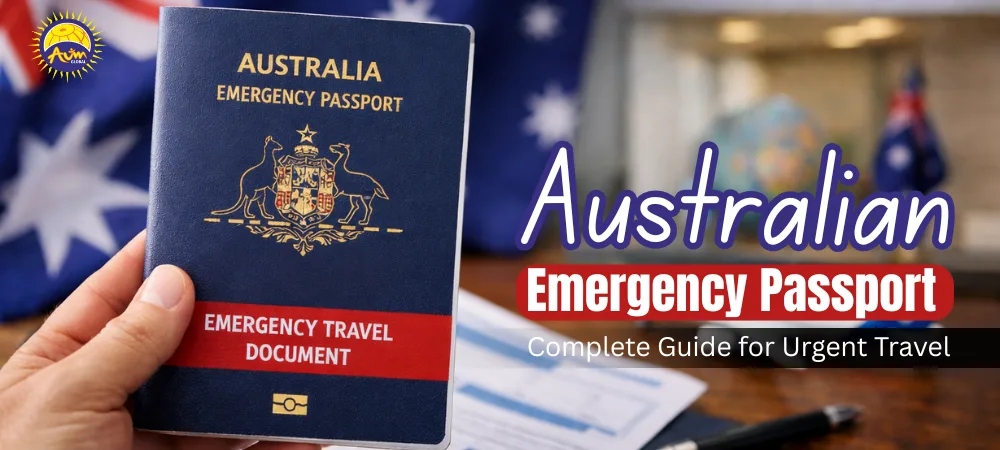
Whether you have lost your passport abroad or suddenly must travel for an emergency, knowing how to get an Australian Emergency Passport can save the day. This detailed guide covers every aspect — from eligibility and application steps to timelines, documents required, cost, renewal tips, and key FAQs. If you are looking for an urgent Australian passport, urgent Australian passport renewal, or help understanding how to secure travel documents fast, you are in the right place.
An Australian Emergency Passport is a temporary travel document issued by the Australian Government when a standard passport cannot be obtained in time for urgent travel needs. It’s typically valid for a short period and intended to get you home or travel to a nearby destination before you obtain a full passport later.
These documents are especially crucial when you have lost your passport abroad or need to depart Australia at short notice. They differ from regular passports because they are issued on urgency, often in less than standard processing times.
You might need an urgent Australian passport if you are:
Abroad and your passport was lost, stolen, or damaged
Required to travel urgently for medical emergencies
Dealing with family crises
Facing unplanned business trips on very short notice
Leaving Australia due to sudden legal or humanitarian requirements
In these cases, applying for an urgent renewal of an Australian passport or emergency travel document is essential.
To qualify for an Australian Emergency Passport, you must:
✅ Be an Australian citizen
✅ Provide proof of urgent travel (e.g., flight itinerary)
✅ Submit identity documents and supporting evidence
✅ Explain why the travel cannot wait for normal processing
Australia’s Department of Foreign Affairs and Trade (DFAT) requires strong proof of urgency — such as flight tickets or hospital letters — before fast-tracking the application.
Sometimes you already hold an Australian passport that is close to expiry. If you must travel soon, consider urgent Australian passport renewal prior to departure. While standard renewals can take weeks, urgent requests aim to reduce that time.
You may also want to know how to renew an Australian passport for future travel — standard steps, timelines, and fees.
Prepare the following:
Proof of Australian citizenship (e.g., birth certificate or previous passport)
Identification documents (driver’s licence, government ID)
Passport photos (meeting official standards)
Evidence of urgent travel (flight ticket, medical letter, or police report)
Visit the official Australian Passport Office (DFAT) website or your nearest Australian consulate/embassy to fill out the form.
Most urgent passport services require in-person verification at an Australian consulate, embassy, or passport office.
Pay the applicable urgent processing fee and submit your documents.
If your passport was stolen, file a police report and attach it to your application for added verification.
When applying for an urgent Australian passport, processing time becomes the most critical factor. Unlike standard passport applications, emergency and urgent services are designed specifically for situations where travel cannot be postponed.
A regular Australian passport application generally takes several weeks to process. This timeline includes document verification, identity checks, printing, and dispatch. Because of these steps, standard processing is not suitable for last-minute or emergency travel plans.
An Australian Emergency Passport is issued much faster. In most genuine emergency cases, processing can take anywhere from 1–3 business days, and in some situations up to one week, depending on:
The nature of your emergency
The completeness of your application
The quality and authenticity of supporting evidence
Your location (within Australia or overseas)
Applications submitted at Australian embassies or consulates abroad may vary slightly in timing due to local verification requirements.
The Department of Foreign Affairs and Trade (DFAT) may fast-track your urgent Australian passport application when it is supported by verified and compelling documentation, such as:
Hospital or doctor’s letters confirming serious illness, surgery, or medical emergencies involving you or an immediate family member
Court summons or legal notices requiring your physical presence in another country
Family emergency itineraries, including proof of death, funeral arrangements, or critical family situations
Providing clear, official documentation significantly improves your chances of faster approval.
If your travel is not an emergency but still time-sensitive, you may opt for a priority processing service. While this does not qualify as an emergency passport, it reduces processing time compared to standard applications and is ideal for:
Unexpected business travel
Upcoming international commitments
Passports nearing expiry with confirmed travel dates
Choosing priority processing early helps avoid last-minute stress and potential travel disruptions.
Always apply as soon as you become aware of urgent travel. Even emergency services depend on document verification, and delays often occur due to missing paperwork or unclear evidence of urgency.
While fees vary by location and urgency, here’s what to anticipate:
Emergency processing surcharge
Standard passport fee
Additional consular charges (if applying overseas)
Australian government fee structures are updated regularly, so always check direct government sources when preparing to submit.
✅ Completed Emergency Passport application
✅ Australian citizenship documents
✅ Valid ID (driver’s licence, Medicare card, etc.)
✅ 2 passport photos meeting official guidelines
✅ Flight tickets / travel itinerary
✅ Police report (if lost/stolen)
✅ Proof of urgency (medical, legal, business)
If you are outside Australia, you will need to apply for your emergency Australian passport at the nearest embassy or consulate. Check the official DFAT page for embassy addresses, contact details, and opening hours.
Embassies also assist with support services if you’re in distress or dealing with theft overseas.
Once submitted:
✔ You’ll receive a receipt
✔ Processing starts immediately
✔ Passport is printed and sent for clearance
✔ You collect it in person (in most cases)
Always check local consulate timelines — they vary by country.
❌ Missing evidence of urgency
❌ Incomplete forms
❌ Photos that don’t meet standards
❌ Not filing a police report for lost/stolen passports
❌ Trying to apply last minute without support
Being prepared significantly speeds up approval.
If you have time before you travel:
✅ Consider urgent renewal of Australian passport
✅ Regular passport is valid up to 10 years
If travel is immediate and cannot wait:
✅ Apply for an Australian Emergency Passport
Both options are valid — choose based on how soon your travel is scheduled.
The fastest way is to visit your nearest Australian embassy or consulate in person with proof of urgent travel, valid identification, and supporting documents. Strong, verifiable evidence often results in quicker processing.
Yes, you can travel internationally, but only to countries that accept temporary or emergency passports. Always confirm acceptance with airlines and destination immigration authorities before booking or boarding.
An emergency passport is usually valid for a short period (weeks to a few months). It is designed only for immediate travel, and you must apply for a full passport afterward.
Yes. A police report is strongly recommended and often required. It supports your application and helps prevent fraudulent use of your lost or stolen passport.
No, emergency passports generally cannot be extended. You must apply for a full passport renewal before the emergency passport expires or after returning to Australia.
Only Australian citizens can apply. You must prove your identity, citizenship, and the urgency of your travel to qualify for emergency issuance.
Yes. If you are in Australia and facing urgent travel, you can apply through an Australian Passport Office, but availability depends on appointment slots and urgency assessment.
No. An urgent passport renewal results in a full-validity passport, while an Australian Emergency Passport is a temporary document issued when time does not allow for renewal.
Fees vary depending on location and urgency. You’ll usually pay the standard passport fee plus an emergency or priority processing surcharge.
Most airlines accept it, but acceptance depends on destination country rules. Always check with both the airline and immigration authorities before travelling.
Having to secure an Australian Emergency Passport or undertake an urgent Australian passport renewal may not be ideal — but with the right information and preparation, you can navigate the process with confidence. This guide has covered everything you need — from eligibility and timelines to documents, processing times, costs, and FAQs.
Whether you’re stuck abroad or unexpectedly called to travel, knowing how the system works can make all the difference for a stress-free journey. Safe travels!


