
Head Office (Melbourne)
Suite 616, 530 Little Collins Street, Melbourne VIC 3000
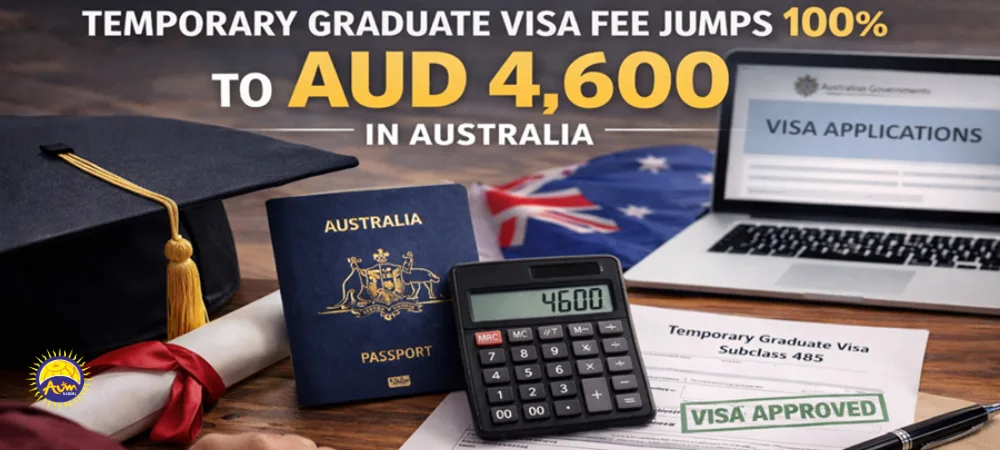
Australia has long been a top destination for international students who want to gain global work experience after completing their studies. One of the most popular pathways for this is the Temporary Graduate Visa (Subclass 485). Recently, the Australian government introduced a significant policy change that has attracted global attention — the 485 visa fees have doubled, rising to AUD 4,600. This sharp increase in the temporary graduate visa fee has raised concerns among international graduates planning to stay and work in Australia after finishing their studies. Understanding the updated subclass 485 visa price, the reasons behind the change, and its impact on applicants is now essential for students and migration planners. In this guide, we break down the updated 485 visa cost, what applicants should expect, and how this change could influence migration strategies for international graduates.
The Temporary Graduate Visa (Subclass 485) allows international students who have completed eligible qualifications in Australia to temporarily live, study, and work in the country.
This visa plays a crucial role in Australia's migration ecosystem by enabling skilled graduates to gain professional experience before applying for permanent residency pathways.
Many international students rely on this visa to transition from study to employment, making the 485 visa fees a significant factor in their post-study planning.
The most notable update is the dramatic rise in the temporary graduate visa fee, which has increased by approximately 100% from 1 March 2026.
Old Fee: AUD 2,300
New Fee: AUD 4,600
Increase: 100% (double)
Effective Date: 1 March 2026
Approx cost for Indians: around ₹2.9–3 lakh
This means the 485 visa cost for a single applicant has effectively doubled. For applicants including family members, the total subclass 485 visa price can now reach AUD 7,000 to AUD 9,000 depending on the number of dependents.
Source: Australian Government – Department of Home Affairs, Visa Pricing Estimator.
The updated temporary graduate visa fee mainly impacts:
International students graduating from Australian universities
Applicants planning to apply for the post-study work stream
Graduates including family members in the visa application
Students budgeting for post-study migration pathways
For many applicants, the increased subclass 485 visa price means financial planning will become more important before applying for post-study work rights.
Policy changes related to migration are often driven by economic, administrative, and labour market factors. The increase in 485 visa fees is linked to several broader immigration reforms.
Australia has been adjusting its migration program to prioritize high-skilled workers and manage visa demand. Increasing the temporary graduate visa fee may help regulate application volumes.
Visa processing involves verification, compliance monitoring, and system management. Higher subclass 485 visa price levels allow the government to recover administrative costs.
Australia’s long-term migration strategy aims to better align international education with workforce needs. Changes to 485 visa cost may encourage applicants to pursue occupations that match skill shortages.
Migration-related fees contribute to government revenue used for immigration administration, border management, and compliance monitoring.
The Temporary Graduate Visa consists of multiple streams designed for different educational backgrounds.
Regardless of the stream, applicants must now pay the updated 485 visa fees when lodging their visa application.
Source: Department of Home Affairs – Temporary Graduate Visa (Subclass 485).
The increase has positioned the subclass 485 visa price closer to some skilled work visa application costs.
The updated 485 visa cost now sits close to permanent skilled visa application fees, which has sparked discussion among migration professionals.
For many students, studying abroad already involves significant expenses, including tuition fees, accommodation, and health insurance.
The increase in temporary graduate visa fee adds another major financial consideration.
This means the total 485 visa cost for many applicants can easily exceed AUD 5,500–6,000.
For graduates already managing student loans or part-time income, this fee increase can influence their decision to remain in Australia.
With the rise in 485 visa cost, international graduates should consider the following steps:
Plan finances for the updated subclass 485 visa price
Check eligibility requirements early
Align study choices with skilled occupation lists
Gain relevant work experience during studies
Seek professional migration guidance if needed
Taking these steps early can help applicants make the most of the temporary graduate visa fee investment and improve long-term migration prospects.
The higher subclass 485 visa price may influence how international graduates plan their migration journey.
Students may begin planning skilled migration pathways earlier in their academic journey.
Courses aligned with occupations on Australia's skilled occupation lists may become more attractive.
Regional universities offering extended work rights may see increased interest.
Students may evaluate whether the temporary graduate visa fee justifies the potential work opportunities.
Migration advisers often recommend long-term planning to ensure the 485 visa fees fit within broader migration goals.
If you are considering applying for the Temporary Graduate Visa, preparation is essential.
Being aware of the updated temporary graduate visa fee can help applicants avoid financial surprises during the application process.
Before applying for the Subclass 485 visa, applicants should carefully evaluate several factors.
Visa fees are non-refundable once the application is lodged.
Policy changes can occur without long advance notice.
Eligibility rules may vary depending on qualification level and study duration.
Migration pathways from the 485 visa to permanent residency are not guaranteed.
Applicants should treat the subclass 485 visa price as an investment in gaining Australian work experience rather than a guaranteed pathway to permanent residency.
Australia remains one of the most attractive study destinations globally. Despite the increase in 485 visa fees, the visa still offers valuable opportunities.
Graduates can gain Australian work experience, build professional networks, and improve their chances of qualifying for skilled migration pathways.
However, policy adjustments suggest that Australia is focusing on attracting high-skill graduates aligned with labour shortages, rather than encouraging indefinite temporary stay.
Understanding how the temporary graduate visa fee fits into broader migration planning will be increasingly important for future applicants.
The 485 visa fees for the main applicant have increased to AUD 4,600, nearly double the previous amount of around AUD 2,235.
Additional applicants aged 18 and above generally pay around AUD 2,300, while applicants under 18 pay approximately AUD 1,150.
The increase is part of broader migration reforms aimed at managing visa demand, recovering administrative costs, and aligning migration programs with labour market needs.
No. The temporary graduate visa fee is generally non-refundable, even if the visa application is refused.
No. The Subclass 485 visa does not guarantee permanent residency, but it allows graduates to gain work experience that may help them qualify for skilled migration pathways.
The sudden increase in 485 visa fees to AUD 4,600 marks one of the most significant cost changes affecting international graduates in Australia. While the temporary graduate visa fee is now considerably higher, the visa still remains an important stepping stone for those seeking Australian work experience.
Students planning to stay in Australia after graduation should carefully assess the updated 485 visa cost, evaluate long-term migration goals, and plan their career pathway strategically.


